
The Complete Wheel Center Cap Size Database: Common Sizes for 50+ Car Brands
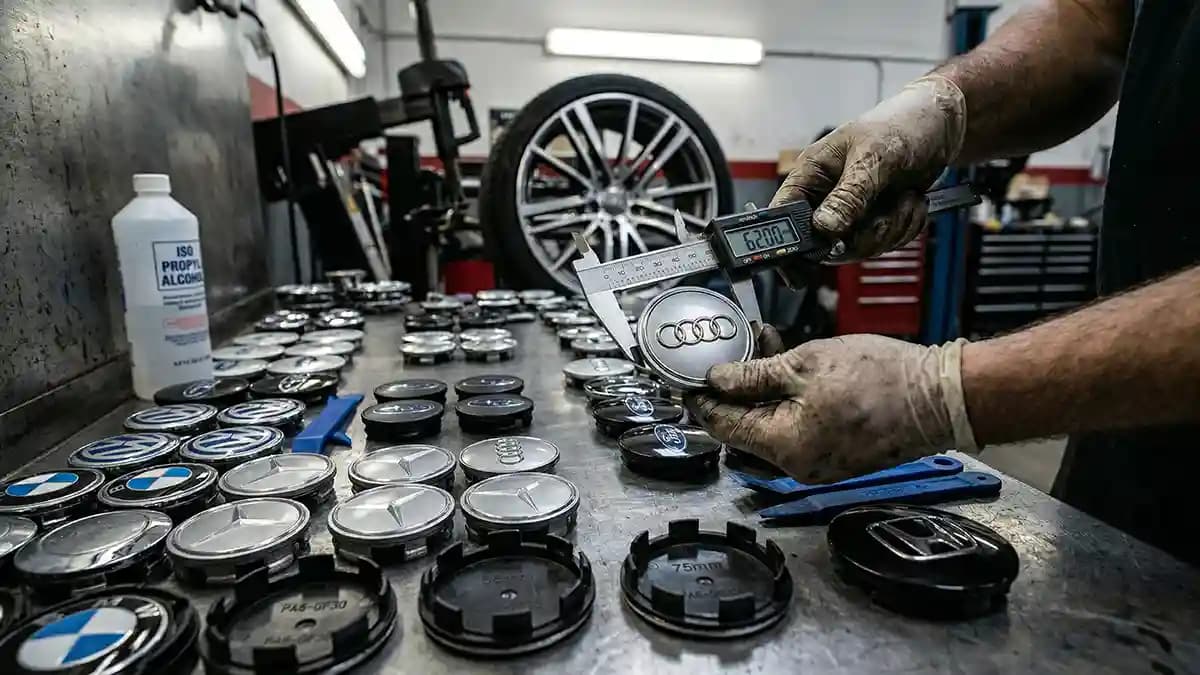
This wheel center cap size chart is the fastest way to stop guessing, because most cars fall into a few common millimeter zones, but the only safe final answer still comes from the cap on your wheel. I learned that with dirty knees in a parking lot, holding two badges that both looked right on my phone and both looked wrong on the car. One sat too proud, one fell inside the ring, and the wheel looked like it got dressed in the dark. That is the whole reason this database exists.
People want one magic chart that says BMW equals this, Toyota equals that, done, easy, go home. Real life is messier. BMW has lived in both 68 mm and 56 mm land, Mercedes listings often talk in 75 mm outer size while the retaining side tells a different story, Porsche owners keep hearing 76 mm for good reason, Audi lives around 69 mm and 60 mm on a lot of jobs, and BBS still bounces between 56 mm and the 70 mm zone depending on the wheel family. (IND Distribution)
I also want to say this before we get lost in numbers. A center cap chart is a shortcut, not a marriage contract. Current parts catalogs and wheel cap retailers show just how wide the size spread gets, with common outside diameters running from the mid 50s all the way into giant full cover territory above 100 mm, and some catalogs reaching 195 mm for older or unusual caps.
Why this chart saves people money
I see the same mistake over and over. Someone shops by car badge, not by wheel, and then acts shocked when the new cap or sticker lands wrong by 1 mm. That tiny miss is enough to make the whole wheel look cheap. It is brutal, because the rest of the car can be clean, polished, and dialed in, and then the middle of the wheel looks like a lazy afterthought.
Here is the part most listings do not explain well enough.
Some sellers list the visible face size.
Some sellers list the back clip or inner size.
Some sellers mix both and hope you sort it out.
Overlay stickers care about the flat front face.
Full replacement caps care about face, clip size, and retaining depth.
That is why current Audi, Mercedes, Porsche, BMW, Toyota, and BBS fitment guides keep circling back to the same boring rule, measure first, then buy. It is boring because it works.
How I use a size database in real life
When I am helping somebody pick a wheel emblem or a domed overlay, I do not treat the brand name as the answer. I treat it like the first clue. Then I check the flat circle on the cap face, because that tells me whether I need 56, 57, 60, 62, 63.5, 68, 69, 70, 75, 76, or something weird that only makes sense on that exact wheel. That one habit saves more money than any coupon code ever will.
Use this database the same way. Start with the brand. Narrow the likely size zone. Then confirm the actual wheel with calipers. If you want the longer measuring version, read Millimeters Matter: How to Use Digital Calipers for a Perfect Fit.
The fast measuring routine
I keep this part simple because overthinking is how people end up ordering twice.
Clean the cap face so you can actually see the true edge.
Measure the flat visible circle, not the raised lip.
Write the number down right away.
If the edge rolls or bevels, go 1 mm smaller.
If you are replacing the full cap, also check the clips on the back.
If the wheel is aftermarket, trust the wheel, not the badge on the hood.
That last one matters a lot. Aftermarket wheels love breaking the rules. A BMW on aftermarket rims can stop acting like a BMW real fast, and the same thing happens with Audi, Toyota, Ford, and pretty much everything else once the stock wheel is gone.
The working database, common sizes to check first
This is not a dealer parts catalog. This is the practical first check list I use before I measure, built around the sizes that keep showing up in current fitment guides, replacement listings, and real wheel emblem jobs. Some brands sit in one tight zone. Others bounce all over depending on model year, trim, and wheel supplier. That is normal.
Europe
Audi, start by checking 69 mm, then 60 mm.
BMW, start by checking 56 mm on many newer cars and 68 mm on many older ones.
Mercedes Benz, start by checking 75 mm visible face size.
Volkswagen, start by checking 55.5 mm, 56 mm, then 65 mm.
Porsche, start by checking 76 mm, then 65 mm on some setups.
Skoda, start by checking 56 mm, 57 mm, or 60 mm.
SEAT, start by checking 56 mm, 57 mm, or 60 mm.
Cupra, start by checking 56 mm or 57 mm.
Opel, start by checking 56 mm or 60 mm.
Vauxhall, start by checking 56 mm or 60 mm.
Peugeot, start by checking 56 mm or 60 mm.
Renault, start by checking 56 mm, 57 mm, or 60 mm.
Citroen, start by checking 56 mm or 60 mm.
Fiat, start by checking 56 mm or 60 mm.
Alfa Romeo, start by checking 56 mm or 60 mm.
Mini, start by checking 54 mm or 56 mm.
Volvo, start by checking 64 mm or 65 mm.
Saab, start by checking 56 mm or 60 mm.
Jaguar, start by checking 59 mm or 63 mm.
Land Rover, start by checking 63 mm or 65 mm.
Bentley, start by checking 65 mm or 70 mm.
Aston Martin, start by checking 60 mm or 63 mm.
Maserati, start by checking 58 mm or 60 mm.
Ferrari, start by checking 56 mm or 60 mm.
Lamborghini, start by checking 60 mm or 63 mm.
Dacia, start by checking 54 mm or 56 mm.
Lotus, start by checking 60 mm or 65 mm.
Rolls Royce, start by checking 65 mm.
The European side is where people get tricked by false confidence. Audi and VW alone can make one chart look smart and wrong at the same time, because one wheel wants a small face, another wants a full cover style cap, and a third wants only the front emblem changed. BMW, Mercedes, Porsche, Audi, VW, Toyota, and BBS guides all point to the same lesson, brand narrows the hunt, but the wheel finishes the job. (IND Distribution)
Japan and Korea
Toyota, start by checking 57 mm, 60 mm, 62 mm, and 63.5 mm.
Lexus, start by checking 60 mm or 62 mm.
Honda, start by checking 56 mm, 60 mm, or 69 mm.
Acura, start by checking 60 mm or 69 mm.
Nissan, start by checking 54 mm, 55 mm, or 60 mm.
Infiniti, start by checking 56 mm, 60 mm, or 66 mm.
Mazda, start by checking 55.5 mm, 56 mm, or 60 mm.
Subaru, start by checking 56 mm or 60 mm.
Mitsubishi, start by checking 60 mm or 63 mm.
Suzuki, start by checking 54 mm or 56 mm.
Isuzu, start by checking 56 mm or 60 mm.
Daihatsu, start by checking 54 mm or 56 mm.
Hyundai, start by checking 56 mm or 60 mm.
Kia, start by checking 56 mm or 60 mm.
Genesis, start by checking 60 mm or 65 mm.
Toyota is a good example of why charts help and hurt at the same time. Current Toyota fitment content keeps calling 62 mm common, and that is true, but real jobs also land at 56, 57, 60, 63.5, and 68 depending on the cap and the wheel. Nissan and Ford live lower in the mid 50s on plenty of setups, while Mazda bounces through 55.5 and 56 more often than people expect.
United States
Ford, start by checking 54.5 mm, 55 mm, or 63 mm.
Lincoln, start by checking 60 mm or 63 mm.
Chevrolet, start by checking 56 mm or 60 mm on many passenger cars, then much larger truck sizes if the cap body is big.
GMC, start by checking 56 mm or 60 mm on lighter duty wheel faces, then larger truck caps when needed.
Cadillac, start by checking 56 mm or 60 mm.
Buick, start by checking 56 mm or 60 mm.
Dodge, start by checking 54 mm, 56 mm, or 60 mm.
Chrysler, start by checking 54 mm, 56 mm, or 60 mm.
Jeep, start by checking 56 mm, 60 mm, or 63 mm.
Ram, start by checking 60 mm, 63 mm, or 70 mm.
Tesla, start by checking 56 mm or 60 mm.
Rivian, start by checking 60 mm or 64 mm.
Lucid, start by checking 60 mm or 63 mm.
American brands are where wheel size and cap size start acting like two different conversations. A small Chevy passenger car center can sit close to European compact sizes, while a truck cap can jump way out of that zone fast. That is one reason I like Shop by brand for browsing and then Toyota collection or Audi collection when I want to compare how different brands present similar size problems on the front face.
The sizes that show up the most
After doing this a stupid number of times, these are the millimeter zones I expect first.
54 mm to 56 mm, very common on Ford, Nissan, VW, Mazda, Mini, and a bunch of compact or older fitments.
57 mm to 60 mm, common on Toyota, Audi oddballs, Honda, Hyundai, Kia, and a lot of aftermarket wheel faces.
62 mm to 65 mm, common where brands sit a little bigger without going into the big luxury cap look.
68 mm to 70 mm, the old BMW zone, a lot of Audi talk, and plenty of BBS and premium wheel jobs.
75 mm to 76 mm, where Mercedes and Porsche people keep living.
Anything bigger than that, slow down, because you may be dealing with a full cap cover, truck hardware, or an unusual wheel system.
That size ladder matches what current fitment articles and retailer catalogs keep showing. Small and medium faces do most of the everyday work, then the luxury and performance brands start nudging you up the scale.
What to do when your size is not on the chart
This happens more than people think. Maybe your wheel has a weird bevel. Maybe the badge area is 61.5 mm and none of the usual guesses make sense. Maybe you have aftermarket wheels and the cap body is fine, but the face is a one off size that no forum thread ever mentioned. That is exactly when a custom overlay stops being a luxury and starts being the smart move.
I would rather order one properly sized emblem than buy two cheap wrong ones and pretend I saved money. If your number is odd, or the cap face is only slightly smaller than a common size, custom is the clean answer. That is where BBS Wheel Center Cap Stickers: Sizing Guide for RS, CH R, CI R, and Classic Rims becomes useful too, because it shows how often “close enough” turns into “why does this look off.”
My blunt final advice
Use the brand list to get into the right neighborhood. Use the ruler or caliper to get the house number. Then buy the emblem that matches the actual face in front of you, not the fantasy in the product title. That is how you stop wasting time, stop wasting money, and stop staring at your wheels every morning wondering why something still looks weird.
A good wheel center does not scream for attention. It just looks right. And when it looks right, the whole wheel suddenly looks more expensive.
Quick Q and A
Q: Is this wheel center cap size chart guaranteed for every model and year?
No. It is a practical starting chart, not a factory service manual. Use it to narrow the search, then measure your exact cap.
Q: What size shows up most on newer BMW wheels?
On many newer BMW setups, 56 mm is the first check. Older BMW jobs still point a lot of people toward 68 mm.
Q: Is 75 mm really the common Mercedes number?
Yes, a lot of Mercedes talk starts at 75 mm for the visible outer face. The inner retaining side can be smaller, which is why listings can sound like they disagree when both are actually talking about different measurements.
Q: Is 76 mm the safe first check for Porsche?
For many later Porsche wheels, yes, 76 mm is the first size worth checking. But it is still not a blind buy. Measure first.
Q: What is the most common mistake people make?
They measure the outer lip or buy by car model only. For overlays, the flat visible face is what matters.
Q: Should I choose the exact size or 1 mm smaller?
If the cap face is dead flat, exact size can look great. If the edge curves or bevels, 1 mm smaller usually looks cleaner and seals better.
Q: Can I use this chart for stickers and full replacement caps?
Yes, but not the same way. Stickers care about the front face. Full caps care about face size, back clips, and retaining depth too.