
Shore Hardness Explained: Finding the Right Shore DO for Your Surface
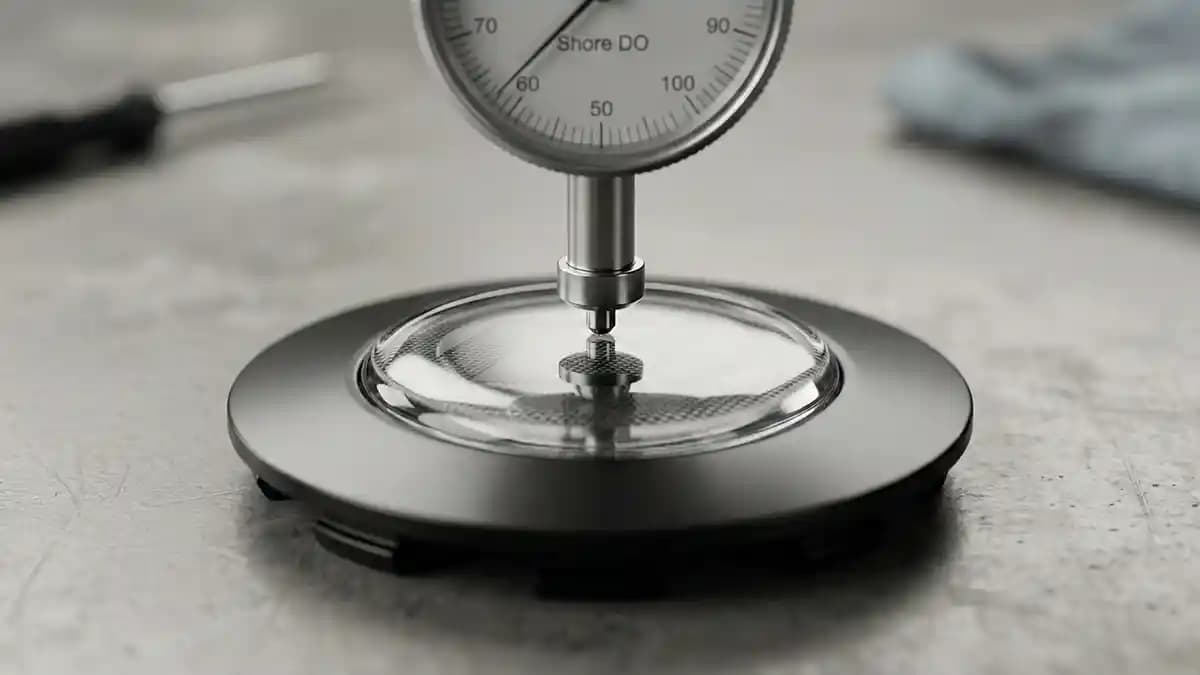
Shore hardness explained in one line, the right Shore DO for your surface decides if a domed sticker looks factory clean for years, or starts lifting at the edges after one wash. I learned this the dumb way, standing in my driveway with a “perfect” new badge that looked like a tiny potato chip on a curved center cap. The print was sharp, the glue was strong, and it still failed, because the dome was too stiff for the shape underneath. Pick the right hardness and the same sticker suddenly feels like it was molded into the cap.
The simple truth about Shore hardness
Shore hardness is a number that tells you how much a material resists a dent when you press it with a standard tip. The test is done with a tool called a durometer, and the common methods are standardized so the readings mean the same thing in different shops. ASTM D2240 is one of the main standards, and it defines multiple durometer types, including Type DO, because not every rubber or urethane behaves the same way. That one detail matters, hardness is not “better” or “worse,” it is “right” or “wrong” for the surface you are sticking to.
Here is the cheat code I wish someone told me earlier, and I keep it in my head every time someone says “my cap is kind of flat.” Most caps are not kind of anything, they are flat or they are curved, and the sticker cares. If you pick wrong, you do not notice it in the first five minutes, you notice it after heat and water have their fun. Pick right and you forget the sticker even exists, which is the best compliment.
Flat cap, pick a stiffer flexible dome so it stays crisp and resists scuffs.
Curved cap, pick an extra flexible dome so the edges stay glued down.
Deep bowl cap, pick extra flexible and do your prep like a robot.
Where Shore DO fits
Most people only hear Shore A and Shore D. Shore A is used for softer rubbers, Shore D is used for harder elastomers and plastics, and many guides list extra scales like Shore 0 and Shore 00 for very soft materials. Shore DO sits inside the ASTM D2240 family too, which is why you see it when people talk about certain elastomers and urethanes. The key rule is simple, a Shore number only means something inside its own scale, so do not try to “convert” DO to A or D with internet math.
The day a stiff dome embarrassed me
A customer wanted to refresh center caps that looked fine from ten feet away, but up close they had pits and that cloudy haze that makes wheels look tired. I made a stiff dome in the correct size, shipped it, and two days later he sent me a photo of a lifted edge that made my stomach drop. The surface was clean and the adhesive was fine, the cap face was just a shallow bowl. A stiff dome wants to stay flat, so when you press it onto a curve it stores tension like a bent ruler, then heat and water keep pulling until an edge creeps up.
Here is how you spot a hardness mismatch fast, and it is always the same story. The sticker looks fine at first, so your brain says “done.” Then the edge starts acting weird, and you start blaming glue, weather, or bad luck. It is none of those, it is the dome fighting the curve. Catch it early and you can change the hardness before you waste another order.
A thin shadow line appears at the edge after a day or two.
You press it down, it feels stuck, then the same edge rises again later.
The dome looks like it is bridging over the middle instead of hugging the cap.
Flexible vs extra flexible in real life
“Flexible” means the dome bends a bit, but keeps a structured lens look. In our setup, that is the 70 to 82 Shore DO zone, it stays crisp on flat faces and handles light scuffs better. “Extra flexible” means the dome follows a curve without fighting, and it spreads pressure across the adhesive instead of pulling at the edge. That is the 45 to 55 Shore DO zone, and it is the difference between “stays down” and “keeps lifting” on concave caps. Shore readings are not magic, they are a quick way to predict if the dome acts like a stiff coin or a soft rubber pad when you press it onto a curve.
A two minute surface test that saves your order
You do not need a lab. You need a straight edge and honest eyes. I use a plastic card, a small ruler, or the edge of a phone, anything straight. Lay it across the exact area where the sticker will sit, then look for daylight under the edge. Rotate and repeat, because some caps curve more in one direction.
Do this in order, and do not skip the rotation part, because some caps curve like a potato chip, not like a bowl. You are not looking for perfect measurement, you are looking for a clear yes or no. If you see daylight, you already have your answer. If you feel rocking, you still have your answer.
Clean the cap face so grime does not fake a “curve.”
Lay the straight edge across the face, look for a gap.
Rotate the straight edge and check again, then press lightly to see if it rocks.
No gap and no rocking means flat, and that is the easy life. Any gap means the face is concave, so the sticker has to bend. Any rocking means the face is not a simple plane, so one edge will be under stress. If you are still unsure, trust the test, not your eyeballs, because your eyeballs lie.
Choosing the right Shore DO range
This is the decision tree I use, and it works.
Choose 70 to 82 Shore DO for basically flat faces
This range is for caps that behave like a table, not like a spoon. The dome stays structured, the print looks sharp under the lens, and the edge stays clean. It is the common pick for modern OEM caps with a flat logo recess. If you are shopping in the main shop, this is the spec behind most “normal” wheel emblem installs.
Good fits include these, and this is where the stiffer dome feels like it belongs. You get that clean lens look without needing the dome to flex much. The adhesive sits relaxed because it is not being forced to bend. And the badge keeps that sharp edge that makes a wheel look newer.
Flat center caps with a shallow logo recess
Flat wheel covers and many aero covers
Interior badge overlays on hard plastic trim
Choose 45 to 55 Shore DO for curved, concave, or raised ring faces
This range saves you on older wheels, aftermarket caps, and anything with a bowl shape. The dome bends with the surface, which keeps the adhesive relaxed instead of being pulled. It also helps when a cap has a raised ring near the edge, because the sticker can nest in without bridging. If your straight edge test shows daylight, this is the safe choice.
Good fits include these, and this is where extra flexible domes feel like a cheat. The dome conforms, so the edge stays calm instead of trying to spring up. Pressure spreads across the whole face, not just the center, which helps long term bonding. If a cap shape makes you nervous, this range removes the stress.
Concave caps on aftermarket wheels
Caps that dome outward, where the center is higher than the edge
Any cap that failed the straight edge test
Glue is not the enemy, stored tension is
Edge lift gets blamed on adhesive, but most of the time it is a stiffness mismatch. A stiff sticker forced onto a curve stores tension, and heat makes that tension move and pull harder over time. That is why some product pages call out flat surfaces, it is a geometry warning, not a vibes warning. This Porsche Emblem Badge Self Adhesive Stylish Design is a good example of a flat face overlay, it is built around a smooth, flat contact area.
If you want a domed option that is built to take daily wheel abuse when the fit is right, look at something like the Porsche Domed Sticker Luxury Edition, then match the hardness to your cap shape before you click buy.
Installation tips that make both hardness levels work
Even the right Shore DO fails if you install it on brake dust and tire shine. Wheels collect oily film that feels dry, but acts like grease under adhesive. Keep the steps boring and strict, it is how you win. Do this.
Wash, dry, then wipe the target area with isopropyl alcohol and let it flash off.
Test place the sticker without peeling, so you know your center point.
Peel, lay one edge, then roll it down slowly while pressing from center out.
Press hard for thirty seconds, then press the edges again.
Then let it sit, because adhesive strength builds over time, not in the first minute. I know that is annoying, because you want to wash the car and stare at it. Do not do it. Give it a full day to settle and grab.
Keep it dry for a full day before a wash.
Install at comfortable room temperature, not freezing cold.
If you already have a slight lift, fix it before it turns into a dirt trap. Warm the area with a hair dryer until the dome feels pliable, then press the edge down hard with a clean cloth. Hold pressure for a full minute, not ten seconds, and keep it dry again for a day. This works best when the edge is still clean, once grit gets under there, replacement is faster.
Real examples you can map to your own wheels
Many Mercedes caps are flat enough that a flexible dome sits down clean and stays down. If you are browsing by brand, the Mercedes section is a good place to see typical flat cap faces. You get a crisp edge and a clean lens look when the surface is flat. And because the dome is stiffer, it keeps that sharp “factory badge” feel under your finger.
Some Mini caps surprise people with more curve than they expect, especially smaller caps that dome outward. That is where extra flexible domes win, because they conform instead of bridging. The goal is boring, keep every edge stuck with zero tension. If you are building a Mini, start with the Mini Cooper section and do the straight edge test on your own cap before you order.
EV wheels are their own animal, because aero covers can be flat, ribbed, or slightly dished in weird ways. Some are plastic, some are painted, and the shape changes from one trim to the next. If you are customizing aero covers, the Aero wheel caps guide is the clean starting point. If you are chasing a quiet look, the 2026 EV minimalist aesthetic post shows why subtle domes fit modern EV styling.
The payoff when you pick the right Shore DO
When Shore DO matches the surface, the sticker lays down calm, no spring, no edge drama. The edges disappear, the gloss looks even, and the badge looks centered from every angle. The best part is that you feel it right away, a good match does not fight you during install. Flat gets flexible, curved gets extra flexible, and you stop wasting money on “almost right” parts.
Quick Q and A
Q: What is Shore hardness in plain English?
It is a number that tells you how hard or soft a material feels when pressed with a standard tip. It is measured with a durometer under standards like ASTM D2240. Higher number on the same scale means a harder material.
Q: What does Shore DO mean?
Shore DO is one of the durometer types defined under ASTM D2240. It is a real measurement type used for certain elastomer materials, not a marketing label.
Q: Which Shore DO range is best for flat wheel caps?
Use the flexible range, 70 to 82 Shore DO. It keeps a crisp edge and does not need to bend much on a flat face. If your straight edge test shows no gap and no rocking, this range fits.
Q: Which Shore DO range is best for curved or concave caps?
Use the extra flexible range, 45 to 55 Shore DO. It bends with the cap and keeps the adhesive relaxed instead of pulling at the edge. If your straight edge test shows daylight or rocking, this is the safe choice.
Q: Why do edges lift even when the glue feels strong?
Because a stiff dome on a curve stores tension, then heat and vibration keep pulling that edge over time. Match the hardness to the curve and the tension drops, so the edge stays down.