
Domed Stickers vs Vinyl Decals for Wheel Caps: Durability, Look, and Value Compared
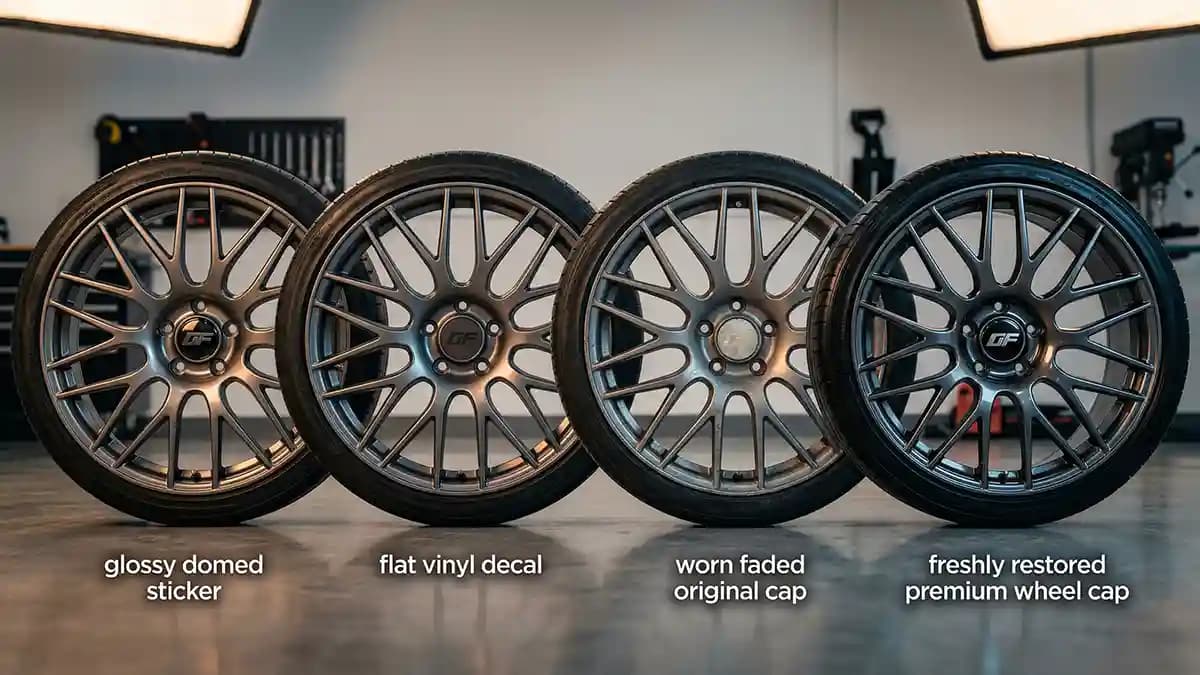
Domed sticker vs vinyl sticker, here is the real answer right up front. If your wheel cap has a flat face and you want the cleanest factory style finish, a domed sticker usually wins. If the cap is curved, the budget is tight, or you just want a fast cosmetic fix, vinyl decals still make sense. I learned this kneeling next to a wheel with two fresh badges in my hand and the kind of confidence that usually ends with me redoing the job twice.
One badge was a thin vinyl decal, slick, simple, and cheap enough that my brain said, yeah, this is probably fine. The other was a proper dome, thicker, glossier, and a little more expensive, which made me squint at it like it owed me a reason. I stuck the vinyl on one cap and the dome on another just to see who would start a fight first. Three washes later the answer was staring back at me, one looked decent, the other looked finished.
What you are actually buying
A vinyl decal is basically a thin film with adhesive on the back and the graphic on top. Good cast vinyl is built for outdoor graphics, and high end films from 3M are marketed for vehicle wraps, accents, and other exterior graphics because they are flexible, pressure sensitive, and made to conform well on smoother surfaces. Some 3M graphic films are also rated for years of outdoor life, but those published numbers are for kinder conditions like flat, vertical, non abusive surfaces, not the center of a wheel that gets blasted with grime and bad decisions.
A domed sticker starts with a printed base too, but then you add a clear resin lens over the top. That clear top changes the whole vibe. It adds real depth, gives the graphic a raised edge, and on a good product it also adds abrasion resistance and a cleaner, more badge like finish. That is why a domed emblem feels closer to a small part than a plain sticker.
Here is what changes the second you add the dome.
You get a thicker face that hides tiny scratches and faded print better.
You get a gloss line around the edge that catches light and makes the badge look more expensive.
You get a surface that usually wipes clean easier after a wash because the top is smooth and raised.
You also get more thickness, more cost, and less forgiveness if the cap face is not actually flat.
Why wheel caps are nasty little test labs
Wheel caps live in a dumb place on the car. They get sun, heat, brake dust, road film, soap, salt, and the occasional high pressure wash from somebody who thinks more force equals more clean. 3M says aggressive washing can damage graphics by forcing water underneath them, which can reduce adhesion and lead to lifting or curling. That matters here because the center of a wheel does not get a calm easy life, it gets peppered all week and judged all weekend.
This is where cheap comparisons go off the rails. People will hold a domed badge and a flat decal in their hand at room temperature and say they look the same. Sure, for ten minutes they can. But a wheel cap is not a shelf, and that is the whole point. The right choice is the one that still looks good after heat, wash cycles, and a month of being ignored.
Durability, the part people fake confidence about
High quality vinyl is not weak, and I want to be fair about that. Good cast films are built for exterior use, and 3M publishes outdoor life numbers that can stretch for years depending on the film and the setup. The catch is buried in the fine print, those numbers depend on the substrate, surface texture, sun angle, prep, and maintenance, and one bulletin spells out that the sample life is for flat, vertical outdoor surfaces in a non abusive environment. A wheel cap is basically the exact opposite of that polite test setup.
A good dome has a different job. It is not only trying to stay stuck, it is also acting like a little shield over the print. Master Bond describes non yellowing polyurethane systems as offering optical clarity and abrasion resistance, Covestro talks about cast polyurethane as a tough material used for high wear parts, and SpecialChem notes TPU for its resistance to abrasion, weathering, wear, and tear. Put in normal human language, a good polyurethane dome is built for getting bumped around without acting like a delicate sticker.
But domed does not always mean better. If your cap face is shallow and curved, or the outer edge rolls upward, a thick dome can fight the shape and start lifting where the edge loses support. That is exactly where vinyl can embarrass a dome, because high end wrap films are made to be more conformable and stretchable around curves and channels. Thin material can be boring in a very smart way.
Use vinyl when these four things are true.
The cap face has a slight dish or curve and you need the material to settle into it.
You want the cheapest clean fix, not the most premium finish.
You like a low key look and do not want a raised lens effect.
You are refreshing the car for now, not trying to forget about the job for a long time.
Use a domed sticker when these four things are true.
The landing zone is flat and gives the edge full support.
You want the wheel center to look more like a real badge than a label.
You wash the car often and want a surface that wipes clean fast.
The original cap looks tired and needs depth, gloss, and a little visual cheating.
The visual cheating part is real, by the way. A dome can make a plain print look sharper because the clear top behaves like a lens, and Impossible Stickers says the same thing in its recent dome content. It adds light, depth, and a more OEM like look, which is why a flat print and a domed print with the exact same artwork can feel like two different products. That little bit of lift does a lot of heavy lifting.
[AI Image Prompt: Realistic split scene in a clean home garage, close up of one alloy wheel with a flat vinyl center cap decal on the left side and a glossy domed center cap sticker on the right side, both applied to similar flat wheel caps, camera at low front angle, soft daylight from garage door, sharp reflections on the domed badge, subtle brake dust on the wheel to keep it believable, premium automotive product photography style, crisp details, natural shadows, no text in the image.]
Look, this is where domed badges pull away
Most people shop this topic with their eyes first, even if they pretend it is about durability. I do the same thing. A domed badge catches light on the edge, throws a tiny shadow, and makes the center of the wheel look finished in a way a flat decal usually cannot. When the rest of the wheel is glossy, machined, or freshly cleaned, that raised look just makes sense.
Vinyl can still look good, and I do not want to insult a clean flat decal. On the right cap it can look simple and sharp, kind of like a factory printed mark. But if the cap has any wear, faded color, or little texture issues, the thin decal tends to show the truth underneath. A dome hides a bit of that ugliness the same way a good clear coat can make tired paint look less sad.
Here is the quick version if you are standing in your driveway with your phone in one hand.
Best for premium look: domed sticker.
Best for tricky curved faces: vinyl decal.
Best for quick budget refresh: vinyl decal.
Best for OEM style depth: domed sticker.
Best for hiding a tired old print: domed sticker.
Best for a lease or short term style change: vinyl decal.
Value is where people get fooled
This is the part that annoys me most, because people think cheap always means smart. Cheap is smart when it works the first time. Cheap is dumb when you buy it twice, clean the cap twice, line it up twice, and still stare at it every time you walk to the car wondering why it looks a little off. That is how a five dollar win turns into a twenty dollar lesson plus your Saturday afternoon.
A vinyl decal often gives you the best price today. A domed badge often gives you the better feeling every time you look at the car. That is not just emotional fluff either, because if the dome is built well and the surface is right, you are paying for finish plus protection plus less chance of wanting to redo the job next month. If the cap face is flat, the value argument leans toward domed faster than most people expect.
Bad value usually looks like this.
Buying a thick dome for a curved cap and acting shocked when the edge lifts.
Buying a thin vinyl decal for a scuffed cap and expecting it to hide the damage.
Sticking anything onto wax, tire shine, or brake dust.
Pressure washing the badge the next morning like you are testing a submarine hatch.
Prep matters more than your sticker type
I know, prep is the boring part. It is also the part that keeps you from blaming the sticker for your own chaos. Recent Impossible Stickers fitment and EV center cap guides keep hammering the same point, measure the visible flat circle, not the outer lip, and if you want a cleaner result buy the same size or 1 mm smaller. That one rule saves people from buying a badge that rides on the edge instead of bonding on the flat landing zone.
Then you clean like an adult. Wash the cap, dry it, then wipe only the bonding area with alcohol and let it flash dry. On the EV center cap guide, Impossible Stickers also says to press from the center outward and then press the full edge, which is exactly what I do when I want the install to stop being dramatic. Simple steps, weirdly powerful result.
My install rule is stupid simple.
Measure the flat circle.
Dry fit the badge before you peel anything.
Clean the exact landing zone, not the whole wheel and then call it good.
Place once, then press center out.
Press the edge like you mean it.
Leave it alone for a day and do not go poking at it every hour.
So what is the best wheel sticker type
The best wheel sticker type is not one product for every car. It is the product that matches the shape of the cap, the look you want, and how much nonsense the car sees every week. That answer is less sexy than people want, but it is the honest one. A domed sticker on a flat cap can look amazing and last well, while a vinyl decal on a curved cap can be the smarter and cleaner choice.
If you want my driveway rule, here it is. Flat face, go domed. Curved face, look hard at vinyl first, or use a dome only if it was built for that shape. And if you do not know which face you have, stop guessing and measure before your wallet learns geometry the hard way.
If you want a place to start shopping, browse the Wheel Emblems collection or jump into the wider Shop and compare styles by size. If you want the deeper material rabbit hole, read Epoxy vs. Polyurethane: The Science of Why Cheap Stickers Fail. And if your wheel setup needs a measurement refresher before you buy, the guide on How To Replace EV Center Caps on Model 3/Y Aero Wheels shows the exact flat circle logic that keeps people out of trouble.
Quick Q and A
Q: Do domed stickers always last longer than vinyl decals?
Not always. On a flat cap with a good polyurethane dome, they usually give you better finish and more protection. On a curved cap, a thin vinyl decal can actually be the smarter long term choice because it conforms better.
Q: Can I put a domed sticker over a faded old emblem?
Yes, if the landing area is flat and the old surface is solid, clean, and not flaking. If the old emblem is raised, chipped, or curved at the edge, do not gamble, remove it or use a solution that matches the shape.
Q: Why does a wheel sticker peel at the edge first?
Usually bad prep, wrong size, or wrong shape for the surface. The edge is where weak cleaning, a raised lip, and water pressure expose the lie.
Q: Is vinyl cheaper because it is worse?
No. Vinyl is cheaper because it is simpler and thinner. Sometimes simpler is exactly what the wheel cap needs.
Q: What would you buy for your own car?
If the cap face is flat, I buy the dome every time because I like the finished badge look. If the face is curved, I stop being stubborn and go vinyl before I waste money proving a bad point.