
Porsche Wheel Center Cap Emblems: Colored Crests, Black Logos, and Custom Sizes
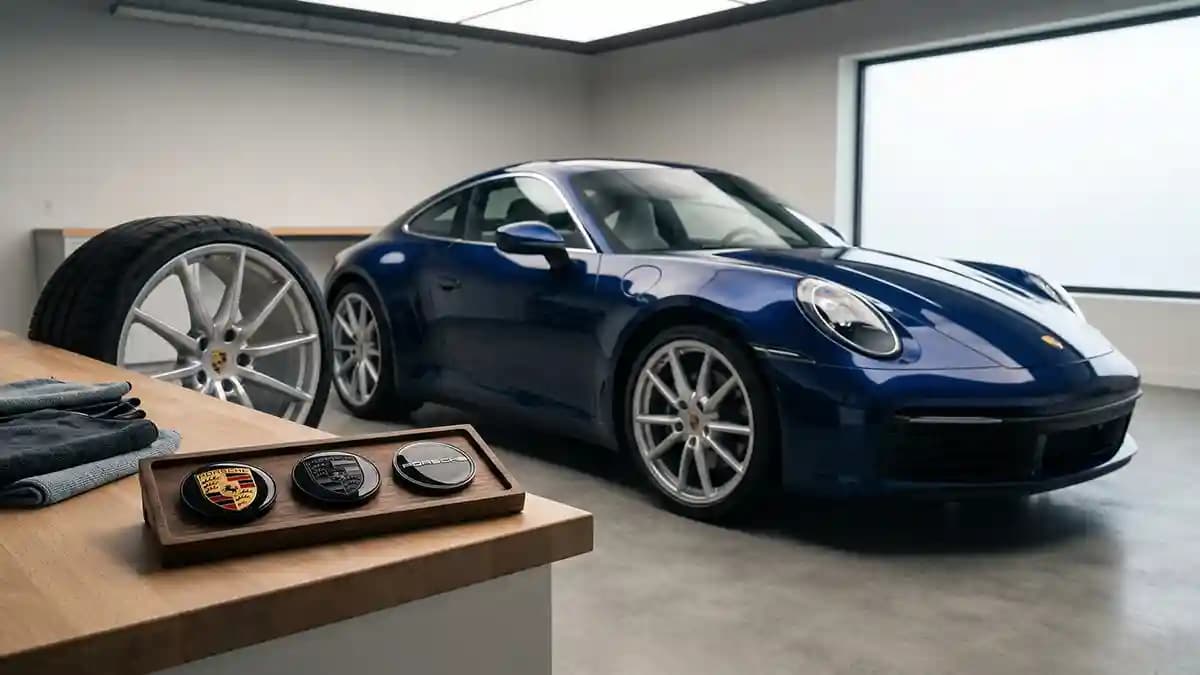
Porsche wheel center cap emblem choice is simple when you strip the drama out of it, colored crests suit classic or heritage leaning cars, black logos suit darker modern builds, and custom sizes win any time the wheel in front of you is not playing nice with stock parts. I learned that crouched next to a black 911 with one bright cap, one faded cap, and two others that looked like they came from a box of random leftovers. The center caps looked like four guys who showed up to a wedding in four different suits.
The good news is Porsche still treats wheel center caps as a real style choice. Recent Porsche listings and accessory pages show monochrome crests, full color crest upgrades, black high gloss hub covers with a colored crest, and even Turbonite crests on current Turbo models. The catch is fitment. A lot of owners hear “Porsche cap” and jump straight to 76 mm, and yes, that size is very common on many later wheels, but not every Porsche wheel, not every older cap, and not every aftermarket setup follows the same script.
I also followed your uploaded post brief for number 176 and the newer house rules for structure, no dashes, one image prompt, and the Porsche focus on colored crests, black logos, and custom sizes.
Why Porsche wheel caps matter more than people admit
A Porsche makes small details feel loud. You can get away with a scruffy center cap on a regular daily driver and most people will never notice. On a 911, Cayman, Boxster, Macan, Cayenne, Panamera, or Taycan, that tiny badge sits in the middle of a wheel people already stare at. Once it looks wrong, your eye keeps coming back to it.
That is also why the wrong style hurts more on a Porsche than on most brands. Porsche has one of the most recognizable crests in the car space, with the gold shield, red and black fields, antlers, and Stuttgart horse tied to decades of brand history. Porsche Classic still leans into those traditional crest colors, while current Porsche accessories and current vehicle listings show the company also pushing monochrome and Turbonite looks on newer cars and trim packages. Change the cap style, and you change the whole tone of the wheel.
Here is my blunt order of operations.
Match the car’s age and mood first
Colored crest for brighter, classic, or heritage leaning builds. Black logo for dark trim, dark wheels, and newer aggressive setups.Match the wheel finish second
Bright caps on satin black wheels can look amazing, or look like you dropped jewelry into a combat boot.Match size third, but check it like it is first
If the emblem lands wrong, none of the style talk matters.
Colored crest or black logo, which one actually looks better
People want a magic answer here. There is none. There is only the answer that fits the car.
Colored crests make sense when the car already has some warmth in it. Think guards red, racing yellow, gentian blue, silver, chalk, or bronze and aurum accents. Porsche’s own heritage material still centers the traditional crest colors, and Porsche also sells full color wheel center cap options on current vehicles and accessories, so the colored look is still very much correct if that is what you want. It does not read old, it reads intentional.
Black logos are for restraint. If your 911 or Cayenne has black trim, black mirrors, smoked glass, and darker wheels, a bright multi color crest can feel too chatty. Monochrome caps calm the center of the wheel down. Porsche has current accessory parts in monochrome for certain wheel finishes and current 2026 cars still listing monochrome wheel center caps as standard or included equipment, which tells you this look is still factory approved.
My easy rule is this.
Colored crest if you want the wheel center to speak
Black logo if you want the wheel center to whisper
Turbonite if the car already speaks Turbo in the new Porsche language
And yes, Turbonite changed the conversation a bit. Current 2026 Turbo listings and configurator PDFs show Porsche using wheel center caps with the crest in Turbonite on Turbo models, which gives owners one more factory backed lane between full color and plain black.
The truth about Porsche 76 mm center caps
This is where people get burned.
Seventy six millimeters is a common Porsche center cap diameter on many later wheels, and parts sellers plus owners keep repeating that number for a reason. You will see 76 mm attached to gloss black Porsche cap sets, later concave caps, and a lot of 911, Cayenne, Panamera, Macan, and Taycan conversations. But common is not universal. Some older cars, some wheel specific caps, and plenty of aftermarket wheels break that rule.
I have watched people order 76 mm just because “that is what Porsche uses.” Then the badge arrives and sits on the bevel, or drops inside the recess, or covers the crest body but not the visible landing area. That tiny miss makes a premium wheel look weird in one second. Close is not close enough here.
This is how I think about Porsche sizing.
If you have stock late model wheels and current cap bodies, 76 mm is the first size worth checking
Not the first size worth buying.If you have older factory wheels, measure the actual cap and the visible face
Older Porsche parts enjoy making your afternoon harder than it needed to be.If you have aftermarket wheels, stop thinking “Porsche size” and start thinking “this wheel size”
The wheel decides first.If you are buying an overlay and not a full snap in cap, measure the flat landing zone in millimeters
Do not measure every outer lip and ridge if the emblem only sits on the center face.
If you need a measuring refresher, read Millimeters Matter before you buy anything. It will save you from doing the classic “looks close on my phone screen” mistake.
Custom sizes are often the smart option
A lot of Porsche owners hear “custom” and picture some wild crest with flames and terrible life choices. That is not what I mean. Most custom sizing is boring in the best way. It means you measured your exact wheel center, picked the exact diameter that lands on the flat face, and got a badge that looks like it belonged there all along.
That matters even more once you leave stock wheels. Victor Equipment, BBS, HRE, Vossen, Rotiform, refurbished classics, forged sets, random takeoffs from a guy three towns away, all of that changes the center area. Some take OEM style caps. Some do not. Some have a blank center where an overlay looks perfect. The point is simple, custom size work is often how you get back to an OEM looking finish when OEM no longer fits the wheel you actually have.
That is why I like the Porsche collection and purpose built products like Porsche Wheel Emblems and Porsche Domed Emblem Premium Edition. They cover a broad size range, and the real win is not just the logo, it is getting the diameter right for the wheel face you actually have. Impossible Stickers lists Porsche options from 20 mm to 120 mm with custom sizing available, which is exactly the kind of flexibility Porsche owners need once the car stops being bone stock.
What material gives the best Porsche look
Cheap shiny is not premium. It is just loud for a week.
If you want a Porsche wheel cap to look convincing, the surface has to do two things at once. It has to keep the crest sharp, and it has to add some depth so the badge does not look flat and dead in the middle of an expensive wheel. That is where a good domed badge earns its keep. The dome acts like a clear lens, which is why details can look deeper and richer than a flat print.
I would skip bargain epoxy for Porsche wheel work unless you enjoy repeating jobs. The better move is polyurethane or a high quality domed resin setup that stays clear outside and keeps the edges from going ugly. The current Impossible Stickers Porsche product pages lean hard on UV resistance, waterproofing, scratch resistance, and that domed lens effect, and their related materials article makes the same case against cheap epoxy. That lines up with what owners actually want, a badge that still looks clean after sun, washes, and daily grime, not just on day one in the kitchen under perfect light. If you want the full material breakdown, Epoxy vs. Polyurethane is worth your time.
That right there is the style decision in one frame. One side feels classic and rich. The other feels colder, meaner, and more modern. Neither is wrong. But one will suit your build better, and if you pick without thinking about the wheel finish, brake color, trim color, and body tone, you are basically dressing in the dark.
My install routine for a Porsche wheel emblem replacement
This is where most people mess it up, not in the buying, in the five minutes before sticking it on.
Clean the face like you mean it
Brake dust, wax, tire dressing, old glue, and hand oils are the enemy.Measure the flat circle, not the outer drama
The part that matters is where the emblem sits.Test center the badge before peeling
Ten seconds here saves a dumb mistake.Peel, place, then press from the center out
Do not mash one edge first like a man fighting a mosquito.Leave it alone after install
Do not wash the car right away just because you got excited.
Most quality Porsche overlays install fast, and Impossible Stickers says the basic clean, peel, press process takes under ten minutes for all four wheels. That sounds about right when the caps are already prepped. The main thing is using them on a clean, flat surface, because even the best emblem cannot win a fight against grease and bad alignment.
When to replace the whole cap and when to use an emblem overlay
Not every problem needs the same fix.
Use a full cap replacement if the clips are broken, the cap body is cracked, the plastic is warped, or the whole center assembly is missing. Use an emblem overlay when the cap body is still fine but the visible crest is faded, chipped, scratched, or just ugly. That second job is where overlays shine. They save the look without making you buy hardware you do not need.
I like overlays even more on older Porsches and discontinued wheel designs for that reason. Porsche still sells certain classic hub caps and crest parts for some old applications, but older cars and special wheels can turn parts shopping into a scavenger hunt fast. If the body is healthy and the visible face is the only sad part, covering the face with the right size and finish emblem is usually the smarter move.
The best style combos by build type
You do not need a design degree for this. You need honesty about the car.
Heritage or classic feel
Go with a colored crest, bright metallic wheel tone, and a badge with real visual depth.Modern black pack build
Go with a black logo or monochrome crest, especially if the wheels, trim, and glass are already dark.Turbo look in the new Porsche lane
Look at Turbonite aligned caps if the car already uses Porsche’s newer Turbo design cues.Aftermarket wheel build
Pick the size for the wheel first, then choose the crest style that calms the wheel down instead of shouting over it.Daily driver that just needs to stop looking tired
A stock looking colored crest in the correct size is hard to beat.
Quick Q and A
Q: Is 76 mm the standard Porsche wheel center cap size?
It is a very common Porsche size on many later wheels, but not a safe blind buy for every model, every year, or every aftermarket setup. Measure first, then buy.
Q: Do black Porsche wheel logos look more modern than colored crests?
Usually yes. On darker wheels and black trim cars, black logos look calmer and newer. On brighter or more heritage builds, colored crests often look more natural.
Q: Can I use a Porsche wheel emblem replacement instead of buying full caps?
Yes, if the cap body is still solid and only the visible emblem is worn out. If the clips or cap shell are damaged, replace the whole cap body first.
Q: Are custom Porsche emblem sizes only for aftermarket wheels?
No. They are most common on aftermarket wheels, but they also help with older factory wheels, odd recesses, and cap faces that do not match the usual assumptions.
Q: What material looks best for a Porsche crest center cap?
A good domed badge usually looks better than a dead flat sticker because it adds depth and helps the crest read more like a proper badge. The clear top layer quality matters a lot.
Q: Should I match my center cap to the body color?
Not directly. Match it to the wheel finish and the trim language of the car first. That usually gets you closer to the right answer.
When Porsche wheels look right, they make the whole car look tighter. That is why I would not rush this part, even though it is small. Pick the mood, measure the face, and buy the size that actually fits the wheel you have. Do that, and your center caps stop looking like random leftovers and start looking like they were part of the build from day one.