
How to Measure Your Wheel Center Cap for a Perfect Sticker Fit, Photo Guide
How to measure wheel center cap sticker size is simple, measure the visible flat circle in millimeters, not the whole cap, not the outer lip, and definitely not your best guess after staring at the wheel like it owes you money. I learned that the annoying way, crouched next to a friend’s car with a ruler in one hand and pure false confidence in the other. We thought the cap looked “about sixty something,” which is a beautiful sentence right before you order the wrong part. Ten minutes later the new sticker arrived in my head, already crooked, already wrong, already making the whole wheel look cheap.
The good news is this job is not hard. The bad news is a round sticker is brutally honest, because even a tiny size mistake shows up fast when it sits in the dead center of the wheel. Recent fitment guidance still leans hard on measuring the visible flat face in millimeters, and recent examples still keep circling around sizes like 56, 60, 63.5, 65, and 68 mm, which tells you one thing, guessing by brand alone is a trap.
I ask one boring question, where does the sticker actually land. If the answer is “on the flat center area,” great, we can work with that. If the answer is “sort of on a curve, sort of on a ridge, sort of in a bowl,” stop right there, because even nice domed emblems still want a flat landing zone if you want the edge to stay down and the finish to look clean.
Most people overcomplicate this. They measure the whole plastic cap, then the chrome ring, then the hole in the wheel, then their patience leaves the garage. For a sticker or domed emblem, the number you usually need is the visible flat face diameter, the clean round area where the new emblem will sit.
Here is what I tell people to measure first.
Remove the center cap if you can, because measuring on a bench beats measuring while folded like a camping chair next to the car.
Clean the face so dirt does not fake the edge line.
Find the flat circle where the sticker will sit.
Measure straight across the center from one side of that flat area to the other.
Write that number down in millimeters, not inches, not “pretty close,” not “I’ll remember it.”
That flat face measurement is the honest number. Impossible Stickers’ current sizing language also stays centered on millimeters and on the landing zone itself, not on vague “fits this model” promises, which is exactly the right way to do it when a round badge has to look centered from every angle.
I have measured caps with three things. One made me feel smart. One made me feel poor but effective. One made me feel like I was gambling.
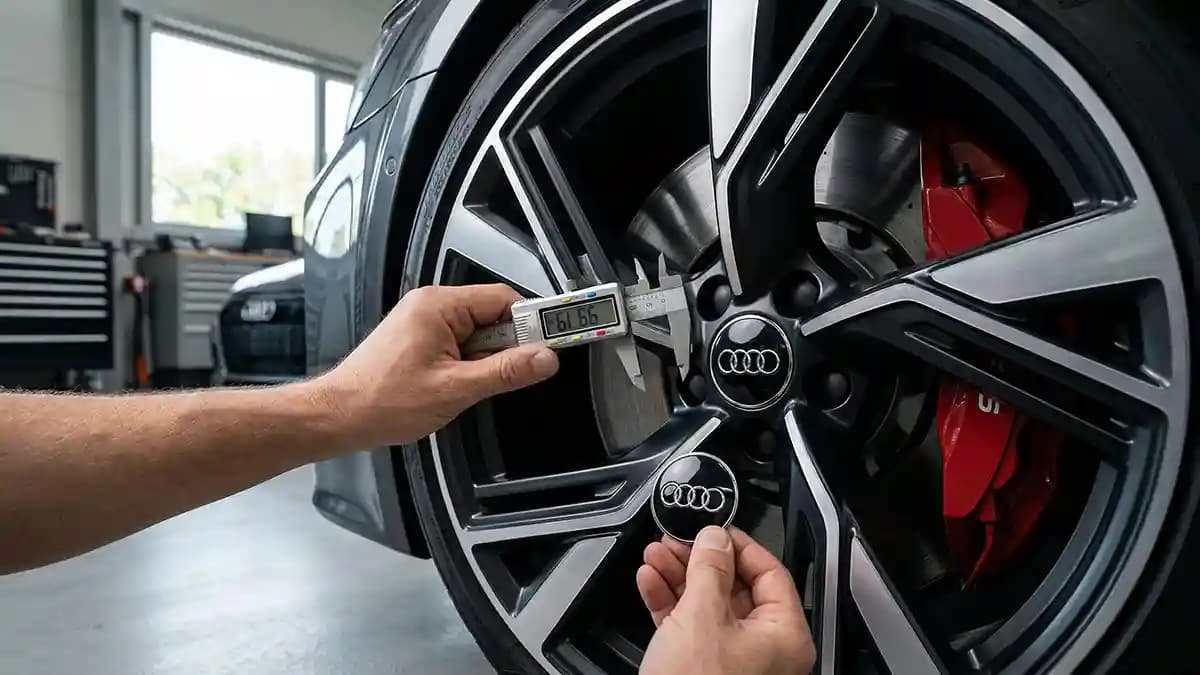
Digital caliper
This is the best tool, full stop. It gives you a clean millimeter reading fast, and it helps a lot when your cap is something annoying like 63.5 mm instead of a neat whole number.Metal ruler
Good enough if the cap is still on the wheel and the flat face is easy to see. You need good light, steady hands, and the humility to measure twice.Paper template
I use this when a cap is curved, scratched, or too awkward to read cleanly. Cut a paper circle, trim slowly, and test fit until it sits right on the flat face.
If you already know you are buying a whole replacement cap for an aftermarket wheel, not just a face sticker, the measurement list grows. Some aftermarket setups need inner diameter, outer diameter, and depth, especially when clips or retention style matter. That is why custom cap sellers still ask for more than one number on aftermarket jobs.
Last week I had four loose caps on a towel, a coffee going cold, and one customer photo on my phone that looked like it was taken during an earthquake. So I went back to the method that almost never fails. It is boring. That is why it works.
Put the cap face up on a flat table.
Use a microfiber cloth and wipe the center clean.
Put the caliper tips on the left and right edges of the flat circle only.
Check the number.
Rotate the cap a little and measure again.
If the number matches, you have your size.
If it changes, you are catching a lip or a curve, so reset and try again.
That second measurement saves people all the time. A lot of wheel caps have a raised ring, a tiny bevel, or a curve that fools your eye. The cap looks flat until the tool tells you the truth, kind of like sweatpants after the holidays.
What most people mess up
This is the part where money disappears. Not a lot of money, usually, but enough to annoy you every time you look at the wheel. The wrong measuring habit creates a sticker that looks slightly too small, slightly too big, or weirdly sunk, and your brain notices it every single time.
I see the same mistakes again and again.
Measuring the whole cap instead of the flat face
Measuring edge to edge across a chrome ring
Using inches, then converting badly
Reading 63.5 as 64 and hoping for the best
Ordering by brand because “all these cars use the same size,” which they do not
Forgetting that newer and older wheel setups inside the same brand can change size
That last one matters more than people think. BMW fitment references still split between 56 mm and 68 mm depending on model generation and wheel setup, so if one brand can swing that much, any quick guess based on logo alone is asking for trouble.
Sometimes you do not want to pop the cap out. Fair enough. Maybe the clips are old. Maybe the wheel finish is mint and you do not want to go poking at it like a raccoon in a trash can. You can still get a good number with the cap installed, you just need to slow down.
Do this.
Park the car where the light is decent.
Turn the wheel so the cap face is easy to see.
Hold the ruler across the center of the flat circle.
Take a straight photo from dead center if your eyes are unsure.
Zoom in and confirm the edge of the flat landing area.
Measure again by hand before you order.
This is also the moment where a photo helps more than people expect. A straight on photo lets you zoom in, check where the flat face ends, and send that image with your millimeter reading if you need a second opinion from a seller. Impossible Stickers even says they would rather help you measure from a quick photo than watch you guess and miss by a hair, which honestly is the mood.
How I handle weird sizes
The weird sizes are where people panic. I actually like them, because once you stop expecting every cap to be a clean whole number, the job gets easier. A modern wheel scene full of custom and aftermarket parts means oddball sizes are normal now, not some cosmic insult aimed at your driveway.
Here is how I treat the common problem children.
63.5 mm
Do not round it up just because your brain likes whole numbers. If the flat face reads 63.5 mm, order 63.5 mm.A cap with a bevel at the edge
Measure inside the bevel, where the flat face ends. The bevel is decoration, not your landing zone.A cap with an old emblem still on it
If the old emblem is flat and intact, measure the emblem itself and then confirm the surrounding landing area. If the old piece is swollen, peeling, or bent, remove it first.A deeply curved or bowl shaped cap
Stop thinking standard dome. On curved caps, fit depends on the actual landing shape, and flat overlays are safer only if there is still a real flat floor in the middle.
Measure more than the face if you are replacing the full cap. For sticker overlays, the face matters most. For the whole cap body, inner diameter and depth can matter just as much.
I get why people search by brand. It feels faster. You type the car model, pick the first shiny result, and hope the internet was in a good mood that day. But wheel centers do not care about your hope.
The current approach on the site is pretty blunt, and I like that. They sell by millimeters because that is the honest way to make wheel stickers sit centered and look intentional, and their recent measuring content keeps repeating the same idea, focus on the flat face, use the size in mm, then buy the emblem that matches the landing zone. (Impossible Stickers) even more once you leave stock wheels behind. The second someone buys aftermarket rims, old size charts get shaky, old brand assumptions get messy, and part numbers plus exact measurements start doing the real work. That is why posts like Millimeters Matter: How to Use Digital Calipers for a Perfect Fit and Finding Emblems for Discontinued Rims: A Solution for Older Cars make sense to keep nearby when you are buying anything custom. (Impossible Stickers) size decision rule
If you only remember one part of this article, make it this. The sticker should cover the visible flat face cleanly without climbing onto a ridge or leaving an ugly ring around the outside. That is the whole game.
This is the rule I use.
Exact match is best when the flat face is clearly defined and your measurement is solid.
Go 1 mm smaller only when the edge line is soft, the outer lip is rounded, or you are not fully sure where the flat face ends.
Do not size up to “cover more,” because oversized circles always look like a mistake.
If the cap surface is curved, textured, or uneven, stop and verify before buying a domed piece. (Impossible Stickers) can matter. On a wheel, a tiny mismatch looks huge because the badge sits in the center, framed by spokes, brake dust, and daylight like it is on stage with a microphone.
When to ask for help instead of guessing
Some jobs are not worth a blind order. I know people hate asking for help on small stuff because it feels silly. But spending two minutes sending a photo is less silly than buying four wrong stickers and then acting offended at geometry.
Ask for help if any of these are true.
You measure two different numbers on the same cap
The cap has a strong curve
The old emblem is missing and you cannot see the original landing zone
The wheel is aftermarket and the brand fitment feels vague
The size lands on an odd decimal and you want confirmation
You are replacing only one cap and need it to match the other three exactly
That is also where the Wheel Emblems section and the Contact page help most. The shop shows how broad the current size range is, and the contact page gives you a clean place to send the photo and the millimeter reading before you order.
A wheel center cap is small. Tiny, really. But when the size is wrong, the whole wheel looks off, like wearing a nice suit with one flip flop. When the size is right, the emblem sits there quietly and makes the wheel look finished, which is exactly what a good detail should do.
So here is the real answer. Measure the visible flat face, use millimeters, double check with a caliper if you can, and stop trusting random fitment guesses that treat every wheel from one brand like the same part. Do that once, do it right, and you save yourself money, time, and the deeply stupid feeling of holding a fresh sticker over a cap and realizing you guessed wrong again.
Quick Q and A
Q: What is the best tool for measuring a wheel center cap sticker size?
A: A digital caliper wins because it gives you an exact millimeter number fast. A ruler can work, but it is easier to misread the edge on small caps.
Q: Should I measure the whole cap or just the center area?
A: Measure the visible flat center area where the sticker will sit. That landing zone decides fit, not the full plastic body.
Q: Can I use a sticker on a curved center cap?
A: Only if there is still a real flat area in the middle. If the face curves hard, the edge can lift and the finish will look wrong. (Impossible Stickers) my size comes out to 63.5 mm?**
A: Order 63.5 mm. This is not the place to round up because a round badge makes small mistakes look big.
Q: What if I am between sizes?
A: If the edge of the flat face is soft or slightly rounded, going 1 mm smaller is usually the safer move. Bigger almost always looks worse than slightly smaller.
Q: Do I need more than one measurement for aftermarket wheels?
A: For a face sticker, usually no, the flat face diameter is the main one. For a full replacement cap, inner diameter and depth can matter too.